





How Packaging Consultants Deliver Supply Chain Optimization Consulting for Savings

Recently, we’ve fielded more requests for help with efficiency as businesses worldwide cope with the effects of a tough economy. To avoid absorbing additional costs or passing them on to consumers, producers are looking for mitigation strategies and tapping consultants in supply chain optimization. With a wealth of experience in materials, packaging design and automation, here’s how our packaging consultants leverage creative problem-solving to help customers optimize supply chains and decrease total operational costs.
Analyze the supply chain for opportunities
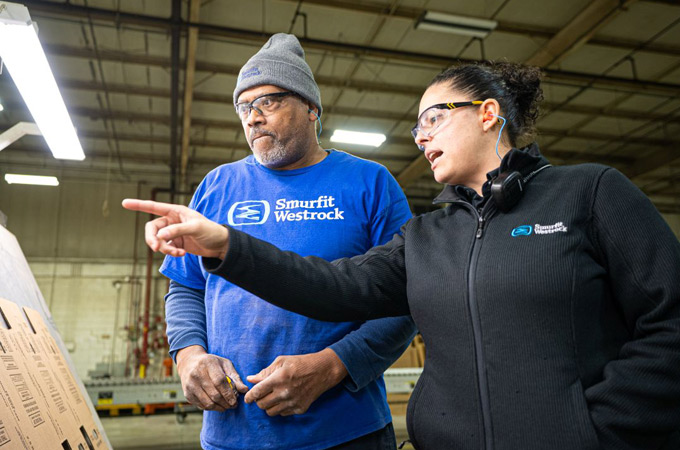
Packaging-led supply chain optimization focuses on finding opportunities for efficiency at every stage of the supply chain. To discuss specifics, our team members invite customers to one of our Experience Centers to explore packaging opportunities, leading to real-time analyses and projections. Team members might also travel to the customer to get a firsthand look at the supply chain in action.Our teams learn as much as they can about a customer’s packaging line and supply chain and then analyze each stage for possible improvements that can lower operational costs. They evaluate:
Packaging Design Optimization
Packaging design optimization is a major part of supply chain design optimization as structural design and materials affect all the following stages of the packaging line.- Whether packaging can use less material overall or a lesser grade of material.
- Possible design changes to primary, secondary or tertiary packaging.
- The layers and types of protective packaging and the possibility of using less.
- Any special preparation used for boxes or containers, such as sterilization or disinfectant.
“We're working on a project right now where we did some testing on the primary packaging and found that it offered significant stacking strength itself, which meant that the corrugated material could then be reduced. So, we recommended going from C flute to a B flute corrugated container,” said Sarah Provost, a Smurfit Westrock packaging consultant.
Palletization and product configuration
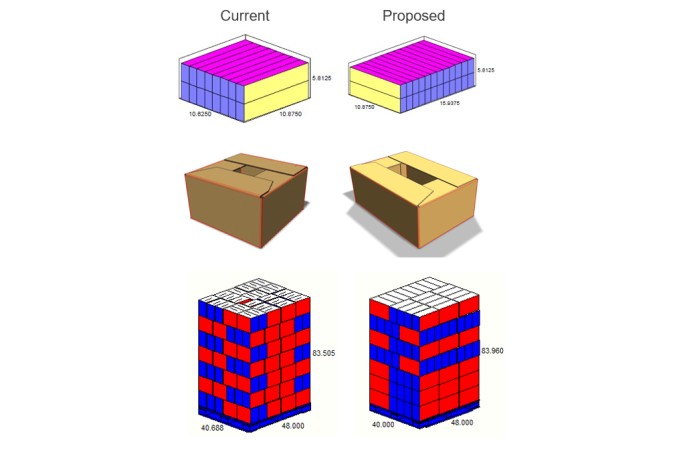
These supply chain optimization techniques allow businesses to unlock savings by improving pallet and trailer/truck usage, which can also reduce emissions.- The configuration of boxes in a case.
- The configuration of cases on the pallet.
- How many rows are in a stack and how high a pallet stands.
- Pallet size compared to containers or trucks and what space might be unused.
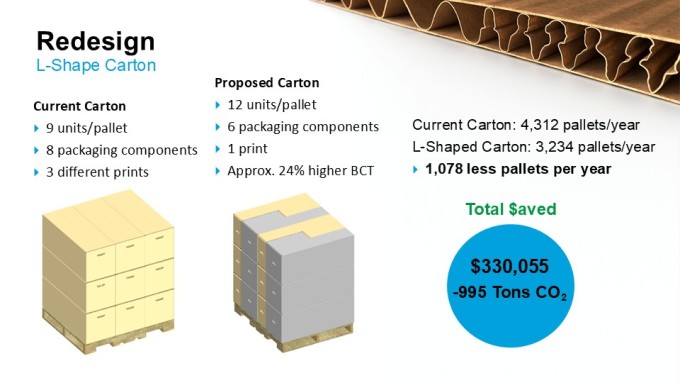
Redesign of this packaging as an L-shaped carton allowed for a better pallet configuration, fitting the cartons together like a puzzle. The ability to put more cartons on a pallet led to major savings in both supply chain costs and emissions.
Labor used
Packaging-led supply chain optimization considers ways to make the packaging process less labor intensive.
- Assembly time and effort required to glue or tape boxes.
- Amount of labor used to pack, store and ship boxes.
- Types of automation used or that could be used.
“When we look at pallet reduction and see that we can eliminate some pallets, that can sometimes reduce labor,” said Provost. “With a significant reduction of pallets used in a year, there is less work needed to move, stack and ship those pallets.”
Adhesives and closure methods
Evaluating all the different ways packaging may be closed and secured can lower the cost of materials and reduce waste.- Amount of glue or tape used.
- How pallets are wrapped. (If wrapped in stretch wrap, could they be wrapped in paper or corrugated material?)
Shipping, transportation and warehousing
Supply chain optimization consulting analyzes how packaging moves once it’s packed and shipped, as well as the tertiary packaging used to move it.- How the product is shipped to distributors. (Pallet, box or in a returnable plastic container?)
- Where and how products are stored.
- Where packaging, storing and shipping locations are in relation to each other.
To help deliver consistent value through evaluation, our consultants often engage SupplySmart, our six-step optimization process. This methodology helps us understand customer challenges, uncover opportunities and design solutions that are scalable, actionable and aligned with real business needs.
Evaluate opportunities to pinpoint the greatest value
Once our team understands the supply chain and analyzes it for opportunities, they can calculate the estimated operational savings: your current costs compared to the projected costs after implementing any proposed packaging changes.
“We have a protein customer that was using returnable plastic containers (RPCs) to get the product to a customer,” said Sean Lemerand, who manages a team of packaging consultants at Smurfit Westrock. “You don't get specialized sizes with those, and they have to be reclaimed, transported, rewashed, etc. We looked at what the numbers would be if they went to shipping in corrugated boxes instead of the RPC, and the supply chain benefit was frighteningly huge.”
At the core of our SupplySmart process is Innotools, a set of proprietary software programs that allows our teams to run calculations, sometimes in real time with the customer, to quantify the value.

“I analyze the data with Innotools to find efficiencies. For example, when evaluating a certain box design, I reviewed over 1000 design variations and selected the most cost-efficient options for the customer to choose from,” said Rodriguez. “Our tools are built and designed for speed, to get the results faster for customers looking to implement quickly.”
If our team hasn’t yet established enough trust for customers to share their numbers or the specifics that have to do with their packaging line, they’re still able to monetize their supply chain recommendations by using estimations, showing customers the possible impact of their ideas.
“If we’re considering the labor involved, we can calculate general numbers based on labor rates in that area,” said Lynn Harmon, a Smurfit Westrock senior packaging consultant. “We’ll tell them, ‘We used a fully loaded labor rate of $75,000.’ And sometimes they'll respond, ‘Oh, no, it's only $65,000.’ Then, we can recalculate it for them to provide something more accurate.”
While showing the savings gain for a simple implementation is usually an easy conversation to have with a customer, sometimes recommendations might include purchasing automated equipment, which can speed up packaging lines, reduce labor and create major efficiencies. With a heftier price tag and possible downtime during implementation, those are harder changes to consider, unless our team can show significant impact when comparing numbers.
“One improvement we recommended for a customer involved investing in automated machinery totaling $2,000,000. When we calculated the cost savings they’d get as a result, the numbers showed they’d pay themselves back in 13 months,” said Lemerand.
Focus on simple supply chain solutions that are easily implemented
For a large producer, making a design change in packaging or buying a new piece of automated equipment can be a major expense and a difficult implementation. Understanding how challenging and time-consuming change can be, our packaging consultants expressed the importance of prioritizing practical solutions that can be easily implemented when it comes to packaging supply chain optimization.
Our consultants say it’s about searching for opportunities to make small adjustments that make a major impact in savings.
“We were working with a healthcare company, and we noticed they had some wasted headspace in the secondary packaging into which the product was packed,” said Smurfit Westrock packaging consultant Jordan Laney. “So, we changed the pack configuration of the product so that we could change the size of the secondary packaging a bit. That eliminated that void space inside the box, which also increased the number of cases we could put on a pallet.”
Putting more cases on a pallet meant the ability to put more cases in a trailer, resulting in less trailers needed each year. Since the company needed to sterilize each trailer load before shipping at a cost of $5000 a trailer, that one change snowballed into a total savings of approximately $1.9 million a year for one implementation.
Our packaging consultants saw many simple opportunities with another customer, a large producer with multiple brands. The company is now working to implement many of the team’s ideas that, in total, created over $200,000 in yearly savings.
“We maximized the height on the inbound packaging coming from our plant, which will reduce trailers outbound as well, we reconfigured their pallet pattern, and they’re looking at gapping flaps on some of their boxes to add a little space between where the flaps meet,” said Provost. “We also made a recommendation to change their glue pattern so they can use less glue to seal their boxes.”
Seek expert supply chain consultation early in the process
“Unfortunately, efficient packaging is often the last thing that gets thought about, and it should probably be the first,” said Lemerand.
The one thing our supply chain experts hear from our customers repeatedly is, “We should have talked to you sooner.” Most put so much thought into perfecting their product or getting the primary packaging “just right” that they place much less importance on the rest of their supply chain...and that’s where they’re missing opportunities affecting their bottom lines.
“A former manager of mine used to say, ‘Boxes cost more to use than to buy.’ You have to make sure your packaging design is correct, because that drives all the other costs down the line,” said Eric Sharp, a Smurfit Westrock packaging consultant.
“They’re failing to capture those savings from the beginning. The price of the package is often what they focus on and don’t realize the impact of that down the line,” Rodriguez said. “They may want the less expensive box, not knowing that, from a total cost perspective, if they choose the more expensive one, they may have more savings overall.”
Talk to a packaging provider before you automate
“Design packaging for the right automation. Don’t choose automation for your current packaging,” said Laney.
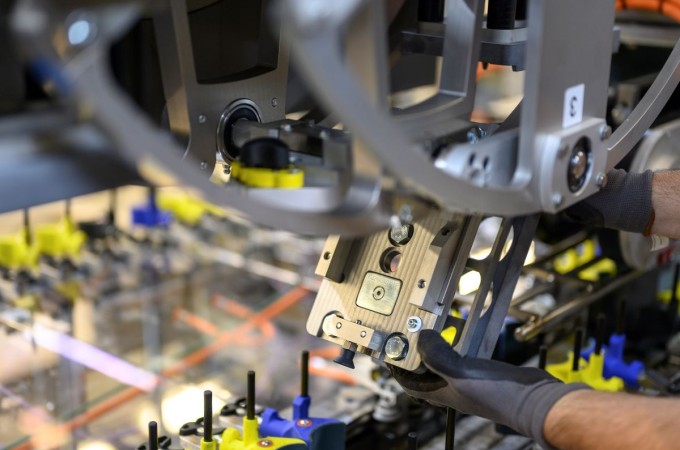
To avoid this mistake, our team says businesses need to choose the best automation for their operation and then redesign their packaging specifically for that machinery.
“We got a call that a customer of ours was moving forward with purchasing an RSC (regular slotted container), which was not the best packaging for that particular product.” said Lemerand. “They had just issued a purchase order for an RSC erector. We had some discussions with them, and within two weeks, we had some new design work to show them there was a more efficient and cost-effective way to execute the wrap. That saved them from buying the wrong machine, which would have been a costly decision.”
Build trust in collaboration with partners
Allowing our team of outsiders to examine and analyze a company supply chain can leave our customers feeling a bit exposed. Effective supply chain optimization consulting always starts with trust: Our consultants and engineers understand that no one will let you look “under their hood” without that. Therefore, they assure customers we’re present only to support.
“To be on this team, you need to have skills in a lot of areas, and one of them is earning credibility with the customer,” said Steve Longa, senior packaging consultant at Smurfit Westrock. “We were with a customer a couple weeks ago and the plant manager had been there 40 years. Everything we said, his reply was, ‘Can't do that. No, not doing that.’ By the end of the day, he was sharing all his numbers with us, because we took the time to earn his trust.”
Additionally, through our Experience Centers, our teams earn customers’ trust through collaboration and immersion. Producers learn more about sustainable supply chain optimization by interacting with physical examples, games and digital representations. All these techniques help build trust and start conversations about their supply chain operations.

"They’re able to interact with what we’re telling them,” said Jose Rodriguez, a Smurfit Westrock Better Planet Packaging engineer. “We make and print out samples, and I introduce a game, ask them questions and get them to guess which one will perform better. So, they engage with the process of figuring out what will be more efficient.”
Your main takeaways on optimizing supply chain for savings
1. Start early.To avoid costly redesigns, work with supply chain experts early to understand the best ways to design your packaging and packaging line for scale. Work smarter and more strategically, not harder.
2. Be open.Supply chain experts are there to help you succeed by learning your operation and then using their expertise to identify valuable opportunities.
3. Choose experienced and genuine packaging supply chain consultants.- The right supply chain experts are partners. They will take time to explore your supply chain with you, help you find opportunities for efficiency, and recommend practical options for your business.
- The right experts will think practically. Their mission is to find quick wins that will make you more efficient and then help you plan for more involved implementations that will pay off over the long term.
- The right experts will want what’s best for your line. They will make personalized recommendations based on your particular product and supply chain, not sell you on a one-size-fits-all supply chain solution.
No matter the size or type of your business, our experts are able to recommend the most efficient options for you to scale, and they provide the numbers, rationale and explanations to support their recommendations. Contact us to learn more about how our supply chain optimization consulting can help you transform your packaging line and unlock value and savings.


Our Latest Blogs